This is an openly opinion-driven column that frames itself as journalism while using first-person advocacy throughout. It is sympathetic to Shiffrin and hostile to her unnamed critics, using language like 'grouches,' 'absurd and more than a little mean,' and 'snide isn't her style.' While entertaining and occasionally insightful, it consistently presents one interpretation as obvious truth.
Loaded LanguageNarrative FramingStraw ManAppeal to Emotion
“I wanted to hear Mikaela Shiffrin scream it, loudly, right there at the finish line.”
“She talked about it, of course, because that's what Shiffrin does... this gets challenged, too -- which is absurd and more than a little mean.”
This piece is openly opinion-forward, repeatedly defending Shiffrin against unnamed critics and using loaded framing like 'peanut gallery' and 'impossible standard.' While much of the factual content is accurate, it is structured as advocacy rather than reporting, with strategic omissions of legitimate questions about her Olympic record and asymmetric framing of critics.
Loaded LanguageNarrative FramingStraw ManSelective Omission
“that's never been good enough for the peanut gallery, which tunes in every four years and doesn't understand why Shiffrin can't just conjure gold medals out of snow.”
“Maybe now they'll finally get off her back.”
This article introduces a Simone Biles comparison to frame Shiffrin's arc, which is thematically apt but editorializes the narrative significantly. The framing of a 'Simone Biles-style comeback on snow' sets a specific heroic template that shapes interpretation. Otherwise factually accurate with good race context and pre-race quotes.
Narrative FramingLoaded LanguageFalse Equivalence
“she completed a Simone Biles-style comeback on snow.”
“Mikaela Shiffrin obliterated her haunted Winter Olympics past on Wednesday in the women's slalom.”
This piece focuses almost entirely on Shiffrin's Instagram posts post-victory, presenting them with minimal journalistic context. The characterization of Shiffrin as an 'Olympic heroine' is editorial, and the article's brevity strips significant context, but its primary content — direct quotes from Shiffrin — is factually grounded.
Loaded LanguageSelective Omission
“It couldn't have gone better for this Olympic heroine.”
“Now, Shiffrin is sending out a strong message about the win, and she's not mincing words.”
A well-constructed narrative feature that includes important context — Shiffrin's thoughts about her father during pre-race catnap, her legacy being secure regardless of result, and the broader Olympic pressure dynamic. Framing is warm but supported by direct quotes, and the piece includes meaningful perspective on why the Olympics disproportionately define careers.
Narrative FramingAppeal to Emotion
“Let's be clear about one thing. Mikaela Shiffrin was going to be fine whether she won that slalom race... or if she skied into the woods.”
“Being great at the Olympics, especially for someone who is great so often everywhere else... is as hard as it gets.”
This article provides one of the stronger accounts of Shiffrin's mindset and the structural pressures of the Olympics. It quotes teammates, provides meaningful race context, and resists reducing the story to simple redemption. The headline about 'peace' editorializes somewhat but the article's body supports it with direct quotes.
Narrative FramingAppeal to Emotion
“She did not have to be reminded of what might happen if things got sideways.”
“The joy isn't in the result, it's in the pursuit of her best.”
This long-form feature offers rich context about Shiffrin's preparation and mindset, including the team combined setback and her technical adjustments. Its framing is largely sympathetic and uses descriptive praise ('greatest skier of all time'), but it earns that framing with substantial factual support and genuine nuance about her struggles.
Narrative FramingLoaded Language
“For Shiffrin, who skis slalom with an engineer's precision, it's all about the turns.”
“How could anyone win a medal with all this weighing them down?”
A feature-style piece with vivid detail about the crash injury and PTSD, providing more context than most outlets about the severity of her physical recovery. Some British tabloid-style phrasing ('banished Beijing demons,' 'Pocket Rocket') adds color without substantially distorting facts. Contains a likely editing error in the final line ('undermines' where context suggests 'underlines').
Loaded LanguageAppeal to Emotion
“she was about a millimeter away from puncturing my colon... we'd be talking about a life-or-death situation.”
“One fan held up a sign saying 'Shriffin GOAT' and in this context, it was a fair comment.”
A balanced narrative piece that actively resists the pure 'redemption' frame, noting Shiffrin's complicated relationship with racing and that the joy is 'in the pursuit, not the result.' Well-sourced with strong direct quotes and contextual depth about the Olympic bargain athletes make. Slight lean toward celebration but well-supported.
Narrative FramingAppeal to Emotion
“She did not come to the Dolomite Mountains to win, which is merely a byproduct.”
“Over the course of 1 minute, 39.10 seconds of brilliance, Shiffrin delivered an indelible run that should shut up the critics.”
Straightforward sports reporting with accurate race statistics and results. Includes split times, competitor outcomes, and direct quotes. Some loaded framing ('whopping fashion,' 'erases years of Olympic heartbreak') but these are proportionate to the story's significance. Includes useful detail about Germany's Duerr straddling the first gate.
Loaded Language
“Mikaela Shiffrin ended eight years of Olympic frustration Wednesday by capturing slalom gold with a commanding 1.50-second victory.”
“Critics had questioned whether the most highly decorated World Cup skier of all time could dominate on the Olympic stage again.”
One of the more thorough accounts, this article integrates race results, historical context, Shiffrin's grief and recovery, and direct quotes. It takes care to note that sports 'love clean narratives' while acknowledging grief is rarely clean — a genuinely corrective framing. Minimal loaded language and strong use of direct quotes.
Narrative Framing
“Sports love clean and tidy narratives like these. The arc from teenage prodigy to veteran champion... But grief is never clean.”
“Everything in life that you do after you lose someone you love is like a new experience.”
One of the more analytically rigorous accounts, providing specific data on Shiffrin's World Cup season form (seven of eight wins), split-time breakdowns, and the team combined context including why Shiffrin's 15th-place slalom split was historically anomalous. Slight framing around 'barroom debate' on GOAT status, but the piece earns its analytical posture with factual support.
Narrative Framing
“The last time she finished 15th or worse in a World Cup slalom race: 2012.”
“In eight World Cup slalom races this season -- seven of which Shiffrin won -- she posted the fastest time in the first run six times. She won all six.”
A well-structured legacy analysis with accurate historical statistics. Covers the team combined setback, Shiffrin's PTSD, and her career arc with appropriate detail. Uses some loaded terms like 'devastating' and 'faltered' but these are largely proportionate to the facts. One of the more factually dense and well-organized articles.
Narrative Framing
“It's one thing to be a prodigy... It's quite another to be dominant.”
“Progress isn't linear, and Mikaela Shiffrin's Olympic career has shown that.”
A brief, factual sports report with accurate race results and context. Light on depth but avoids editorializing. Notes Duerr's gate error and Shiffrin's composure in 2026 vs. 2022. Includes standard promotional links but editorial content is straightforward without significant framing choices.
“After a disastrous run in the 2022 Beijing Games, Shiffrin was able to keep her composure and deliver an incredible run to grab the gold.”
“she had to wait a few agonizing seconds as the two competitors ahead of her failed to make it through the course.”
A factual account with accurate race details, including the useful note that Duerr and Oehlund both skied out in the second run, which affected the final standings. Slight editorializing ('revenge year') but grounded in facts. Includes some minor statistical errors regarding Shiffrin's 2018 medals but otherwise accurate.
Loaded Language
“This Winter Olympics was meant to be Shiffrin's revenge year.”
“Coming into the finish, she squatted down with her head between her knees in relief after she finally got some Olympic redemption.”
This piece is unusual: it opens with a detailed, evocative memory of Jeff Shiffrin's reaction at Pyeongchang 2018, serving as an implicit contrast to his absence now. It's an effective emotional narrative device grounded in real reporting. The article appears to cut off early, limiting full assessment, but what exists is factually grounded.
Appeal to EmotionNarrative Framing
“'Oh my God!' he yelled.”
“it was becoming more and more apparent that Moegg wouldn't catch Mikaela's time, and that Jeff Shiffrin's daughter was about to win her second career Olympic gold.”
A concise, largely factual account with strong use of direct quotes from Shiffrin. Covers the key facts — winning margin, time, father's death, emotional aftermath — without excessive editorializing. Slightly sparse on competitive context (other medalists, race dynamics) but honest and accurate.
“Everything in life you do after you lose someone you love is like a new experience.”
“It is not always easy. Sometimes it feels impossible. In the end, today, it was to take away the noise and be simple with it.”
A factually solid news account covering the race results, Shiffrin's prior struggles at these Games, historical context, and her injuries. Includes a notably gracious Shiffrin quote about competitor Brignone in the GS — context most other outlets omit. Minor inaccuracy in the crash year reference but overall accurate and balanced.
Selective Omission
“That was, like, the greatest show of GS skiing that we've had in a really long time.”
“In 2024, Shiffrin crashed after losing control while on the course for the 2026 Milano Cortina Olympics.”
A technically precise account notable for including the second-run leaderboard drama — Holdener, Truppe, Swenn-Larsson, Rast — giving readers a clearer picture of how the gold unfolded than most outlets provide. Uses 'peerless' and 'imperious' as adjectives but these are proportionate given Shiffrin's margin. Strong factual depth.
“The event took a dramatic turn in the second run with each athlete rising to each new marker.”
“the relief for Shiffrin was palpable, reaffirming her greatness on the biggest stage.”
A solid first-run report with accurate times, Shiffrin's direct quotes, and relevant background on her PTSD recovery and prior Games performance. The pre-race Instagram quote adds texture. Appropriately hedged given it was written before the second run concluded. Clean and factual.
“It was a really good run, for me it felt really clean and really active but also a little bit on the limit.”
“my skiing in the first race didn't come together the way I visualized.”
One of the more complete straight-news accounts, covering race details, emotional aftermath, father tribute, podium ceremony, and historical context. Uses some loaded phrases ('nightmarish 0-for-6') but they accurately reflect the competitive record. Good use of direct quotes from Shiffrin and competitor Rast.
Loaded Language
“When I saw one second (behind) after the first run, I was like, 'OK, the gold is gone.'”
“Maybe today was the first time that I could actually accept this, like, reality.”
Clean, well-sourced wire-style reporting with strong direct quotes and accurate race details. Includes Shiffrin's own reflection on the difficulty of excelling at the Olympics vs. World Cup, a point most outlets omit. The phrase 'born again' is Shiffrin's own language, not the outlet's editorializing. One of the more complete factual accounts.
“Yes, I think it's harder... I wouldn't have said that in Sochi because I was like, what are we talking about? It's just skiing.”
“It felt like it was just on the limit... we're just right nudging against the ceiling here.”
A clean wire-style report with accurate race details, historical context, and direct quotes. The phrase 'nightmarish 0-for-6' is slightly loaded but reflects the factual record. Includes the donate appeal which is editorially unusual but unrelated to bias. Overall straightforward and complete.
Loaded Language
“Shiffrin's turbulent, 12-year Olympic journey came full circle Wednesday.”
“That's all in the past.”
A brief, factual bulletin-style summary. No significant editorializing, relies on direct quotes and accurate statistics. The description of the win as 'climatic redemption' is a mild framing choice but the rest is neutral. Limited depth but minimal spin.
“In the end, today, showing up -- that was the thing I wanted most.”
“It's a climatic redemption for Shiffrin, the Edwards, Colorado, native who didn't make the podium during the 2022 Beijing Games.”
A clean, factual news report covering race results, historical context, and Shiffrin's Games trajectory. No significant editorializing or loaded language. Includes the accurate detail about Shiffrin's Pyeongchang 2018 medals and her 0-for-6 Beijing performance without overdramatizing either. One of the most neutral accounts.
“Shiffrin won her third career Olympic gold medal by finishing 1.50 seconds ahead of silver medalist Camille Rast.”
“Four years ago, she was a favorite in Beijing but went 0 for 6 on podiums and failed to cross the finish line three times.”
A clean, factual summary with accurate times, standings, and context. Includes notable details like Duerr's gate error and Vlhova's placement. Minimal framing, no significant loaded language. Brief and to the point without notable omissions given its news-summary format.
“This is a moment I've been pretty scared of for a long time.”
“Honestly, the skiing is what I cared about.”
A live first-run dispatch with accurate split times, field positions, and Shiffrin's wobble mid-course. Includes the notable detail that a gold in GS would have been a 'bonus' given her recent form — a corrective to the pure drought narrative. Clean, factual, with appropriately limited conclusions given it was written before the second run.
“The reality is a medal in the giant slalom would have been a bonus.”
“For a fraction of a second, it appeared she was headed for another Olympic disappointment. Not this time.”
A factual roundup of U.S. medalists at the Games. Shiffrin's section is accurate and well-summarized without excessive editorializing. The broader article context means no individual story gets deep treatment, but the Shiffrin entry is factually complete and proportionate.
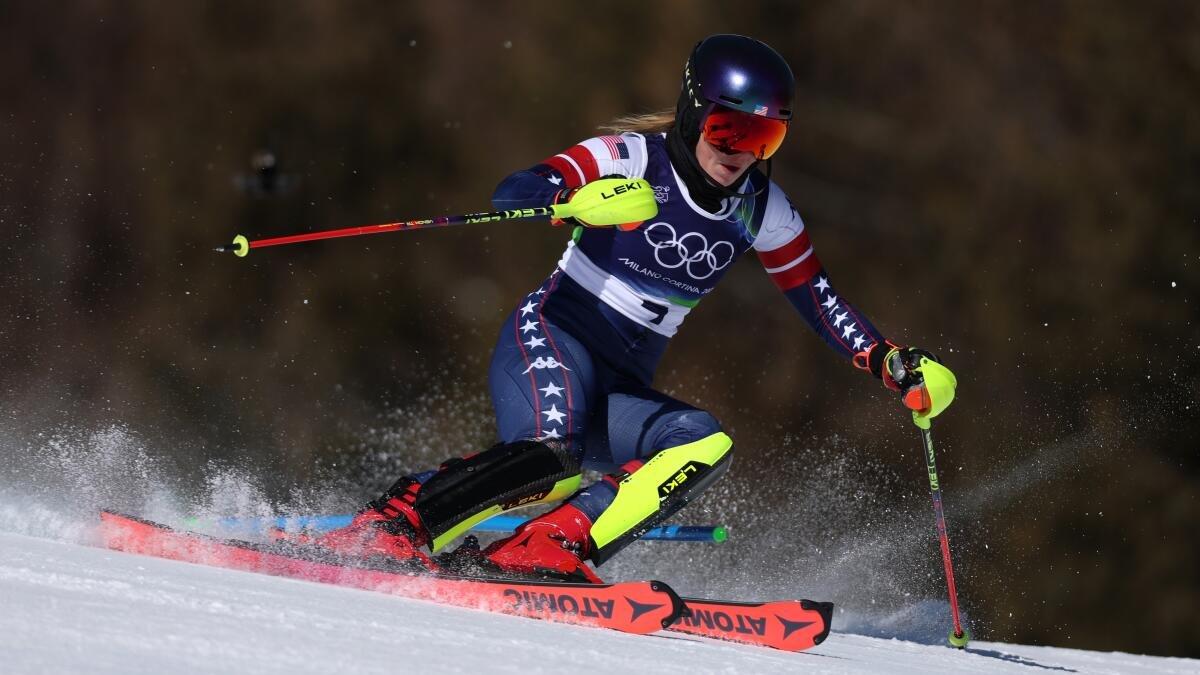
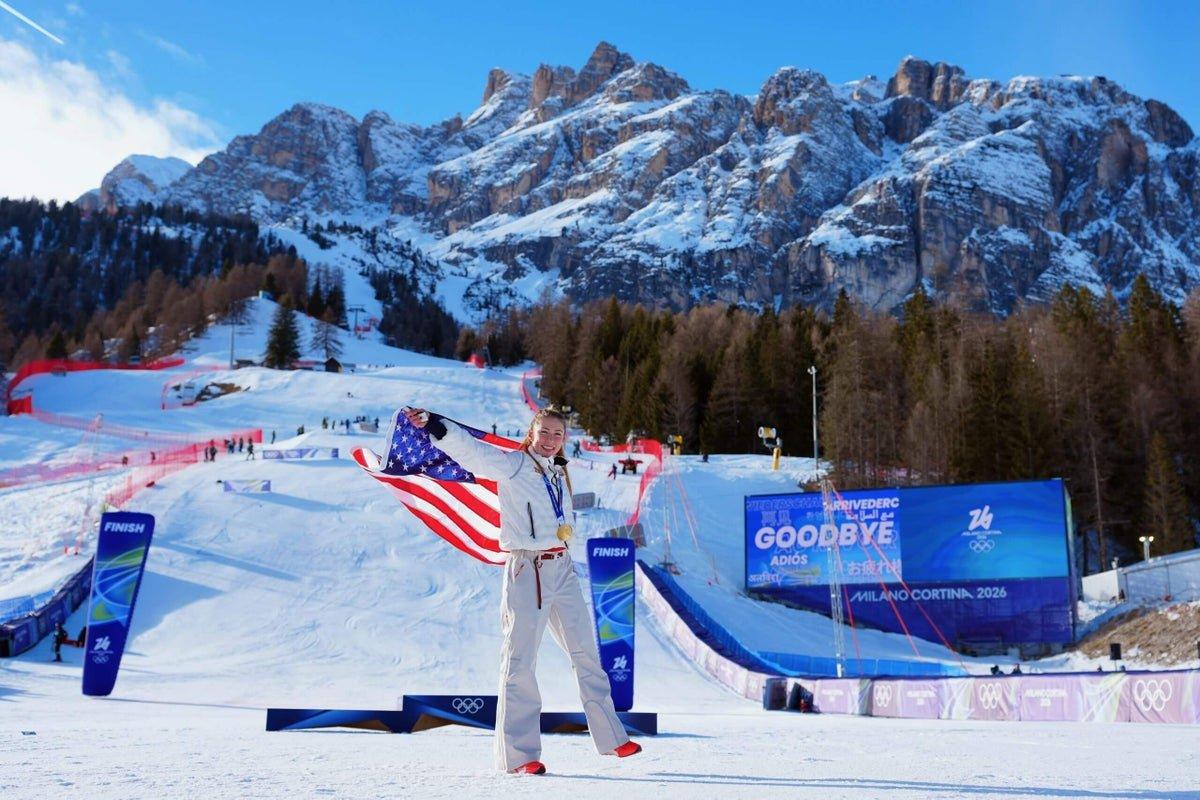
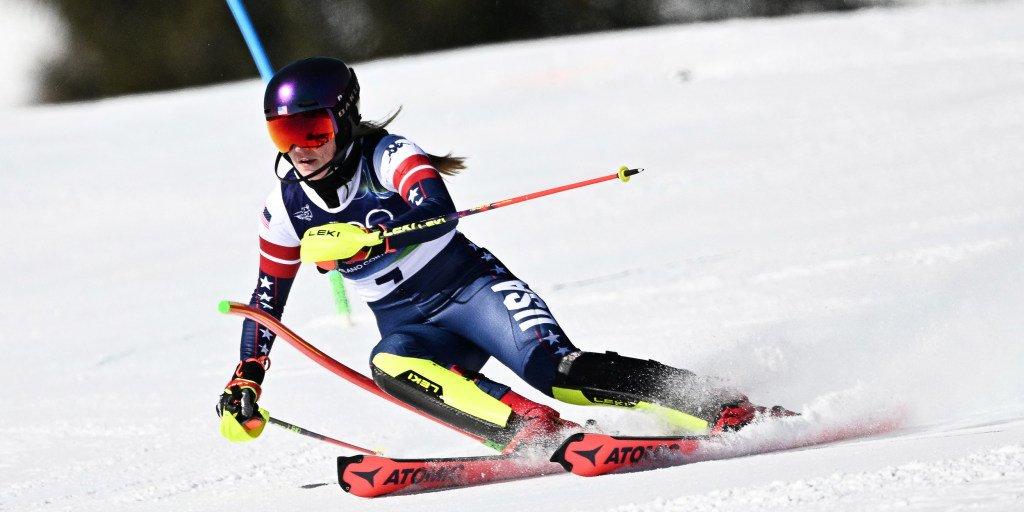
“Shiffrin put in two dominant runs in gorgeous conditions amid the jagged peaks of the Dolomites to win the women's slalom by a massive 1.50 seconds.”
“It made the 30-year-old Shiffrin the first American skier to win three Alpine golds.”