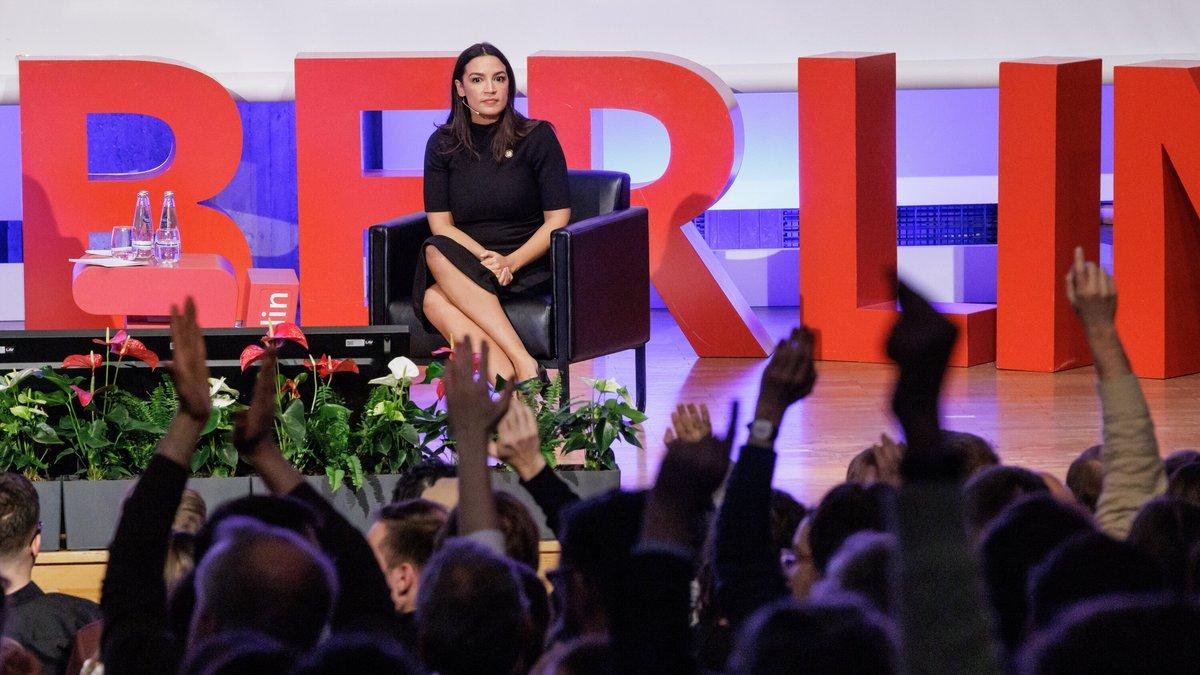
This is a first-person opinion column that makes no pretense of neutrality, opening with personal mockery and proceeding through ideological critique of 'cultural leftism' and 'historical revisionism.' It frames AOC's errors as evidence of progressive ideology's dangers rather than individual stumbles, making sweeping claims about European audiences wanting 'their own culture erased.'
Loaded LanguageAppeal to EmotionNarrative FramingStraw ManContext Stripping
“Can AOC even find the continent on a map? After listening to her say this, I'm doubtful.”
“Is this what progressive leftism -- the ideology of AOC -- seeks to achieve?”
This opinion piece is openly derisive, addressing AOC directly as 'lady' and speculating confidently about her presidential ambitions while dismissing her stated reasons for attending Munich. It mixes editorial mockery with factual reporting in a way that makes the two indistinguishable, and presents conservative interpretations as obvious truths.
Loaded LanguageAppeal to EmotionNarrative FramingStraw ManContext Stripping
“First, stop saying foolish things, lady.”
“Rep. Alexandria Ocasio-Cortez (D-NY) attended the Munich Security Conference for reasons that are hard to understand.”
This opinion column uses sustained sarcasm and dismissive comparisons to mock AOC's intellect and policy knowledge. It frames her foreign policy views as 'Marxist' and 'childish fantasy,' and extrapolates from her conference gaffes to broad ideological claims about the left's hostility to Western civilization, far exceeding what the facts of the story support.
Loaded LanguageAppeal to EmotionStraw ManNarrative FramingContext Stripping
“AOC is to strategic thinkers what Gayle King is to astronauts.”
“her casual disregard for Western culture is symptomatic of a left that, to its shame, considers its own civilization an affront and lie.”
This article uses loaded language throughout ('fumbled,' 'Communist China,' 'word salad') and presents Vance's mockery approvingly while framing AOC's entire political identity as empty sloganeering. It adds additional gaffes beyond the Taiwan moment to pile on, and the closing paragraph editorializes dismissively rather than reporting.
Loaded LanguageNarrative FramingSelective OmissionAppeal to EmotionCollective Narrative Alignment
“Ocasio-Cortez fumbled basic foreign policy questions at the conference on Friday despite having spent months preparing for the event.”
“No, this is a person who is mouthing the slogans that somebody else gave her and it shows how thin the Democrats policy actually is.”
This National Review commentary openly derides both AOC and the newspaper article that defended her, characterizing her responses as proof she 'doesn't know anything' and her ideas as having 'no content.' It mocks her language with a Mad Libs comparison and presents its interpretation as self-evident fact, using adversarial neutrality to appear analytical while delivering pointed advocacy.
Loaded LanguageNarrative FramingStraw ManContext StrippingAppeal to Emotion
“What AOC said didn't mean anything because AOC doesn't know anything.”
“She is a limerick competing with a bunch of novels.”
The article frames AOC's media outreach as a 'cover-up' and 'bailout,' using a Democratic strategist's harshest quotes as the primary framing device. It characterizes her multiple statements as gaffes without acknowledging any substantive parts of her appearances, and labels her errors 'objectively false' while adopting a prosecutorial tone.
Loaded LanguageNarrative FramingSelective OmissionAppeal to Emotion
“It was a horrible idea. It's now getting to the point where the kind of cover-up is worse than the initial crime.”
“Ocasio-Cortez delivered a full weekend's worth of gifts to her conservative critics.”
This article leads with the Venezuela gaffe and frames AOC entirely through her critics, including Glenn Greenwald and partisan strategists. It includes a gratuitous aside about her accent, which has no factual bearing on the story and functions purely to ridicule. It notes her international relations degree as ironic context rather than neutrally.
Loaded LanguageSource Selection BiasAppeal to EmotionNarrative FramingSelective Omission
“Conservatives swiftly capitalized on the remark, portraying AOC as both overly self-assured and demonstrably misinformed.”
“Additionally, online users pointed out that the lefty representative purposely pronounced 'Venezuela' and 'Maduro' with a clear accent, despite having an American accent herself.”
This article frames Trump's criticism as personal grievance ('rages,' 'lashed out,' 'being mean') rather than political commentary, using loaded language to diminish his response. It foregrounds his age in the headline, which is irrelevant to the story. It gives substantially more favorable framing to Democratic figures while presenting Republican responses as petty.
Loaded LanguageAppeal to EmotionNarrative FramingContext StrippingSelective Omission
“Trump, 79, Rages at Rivals Being Mean About Him on World Stage”
“The president lashed out at two leading Democrats who dared criticize him 'on foreign soil.'”
This podcast summary presents commentary from panelists who describe AOC as 'ignorant and smug,' and frames Newsom's claims of dyslexia mockery as a demonstration of Democratic 'victimhood culture.' The framing consistently favors conservative interpretations without presenting substantive counterarguments.
Source Selection BiasLoaded LanguageNarrative Framing
“She's ignorant and smug about it.”
“not to take on the argument, just to claim victimhood, shows Newsom really is a modern Democrat.”
This article relies heavily on critics — Trump, Halperin, the Washington Post editorial board — to characterize AOC's trip as a failure, with minimal space given to positive European reception. The framing is adversarially neutral: it quotes AOC's own words but contextualizes them only through critical lenses.
Source Selection BiasNarrative FramingSelective OmissionCollective Narrative Alignment
“The usually poised politician often appeared out of her depth as she tried to graft her class-warfare politics onto foreign policy.”
“I think giving AOC a slot may go down in history as one of the bigger mistakes she's ever made if she wants to be president.”
This article centers Trump's criticism while including his quotes about Newsom and Clinton for context. It uses the phrase 'word salad' sourced from a partisan communications director without balance, and the framing consistently presents the critics' perspective as authoritative while giving no space to AOC's response or positive European reactions.
Source Selection BiasNarrative FramingSelective OmissionCollective Narrative Alignment
“AOC might be even worse than Kamala Harris when it comes to the word salads.”
“Ocasio-Cortez delivered a word salad at one point during the conference.”
This article is relatively straightforward in reporting Trump's remarks and quoting AOC's actual words on Taiwan and Venezuela. It relies on insider links ('RUBIO SHINES ON GLOBAL STAGE WHILE AOC, WHITMER, AND NEWSOM TAKE HEAT') to editorialize through navigation rather than text, and omits any positive reception she received in Europe.
Selective OmissionCollective Narrative AlignmentNarrative Framing
“This was not a good look for the United States.”
“The Democrat lawmaker from New York and potential 2028 presidential candidate has been facing criticism for making foreign policy gaffes at the event.”
This article provides relatively balanced coverage, including both Trump's criticism and substantive quotes from AOC's actual speeches about inequality and authoritarianism. It notes Trump's apparent slip confusing Munich with Geneva, which other outlets omit. It characterizes the trip more completely than most, though it still centers the political conflict over substance.
Collective Narrative AlignmentSelective Omission
“Trump seemed about to say that Newsom was in Geneva, having just answered a question about how the Swiss city was set to host peace talks between Russia and Ukraine.”
“I believe we're seeing in economy across economy around the world, including the United States, that extreme levels of income inequality lead to social instability.”
This article is the most complete in presenting AOC's full context — her stated purpose, positive European reactions including named foreign officials, and her own explanation of her frustrations. It describes the Taiwan answer as reflecting 'strategic ambiguity' policy rather than pure ignorance. It gives noticeably more weight to AOC's perspective while not omitting the criticism, making it center-left in balance.
Selective OmissionCollective Narrative Alignment
“On the ground in Germany, the reaction to Ms. Ocasio-Cortez's visit seemed mostly positive, at a time when many of the United States' traditional Western allies are alarmed by President Trump's hostility.”
“She stalled for roughly 20 seconds before offering a response that reflected the United States' longtime policy of strategic ambiguity.”
This is among the more factually grounded articles, including AOC's actual quoted response to the Taiwan question and noting that the clip was aired without showing her full answer. It reports Vance's criticism accurately without excessive editorializing, though it does not include any European reactions or context about strategic ambiguity.
Selective OmissionCollective Narrative Alignment
“The vice president claimed the clip, which Fox News aired without showing the congresswoman's actual response, illustrated 'a person who doesn't know what she actually thinks.'”
“She stalled for roughly 20 seconds before offering a response that reflected the United States' longtime policy of strategic ambiguity.”