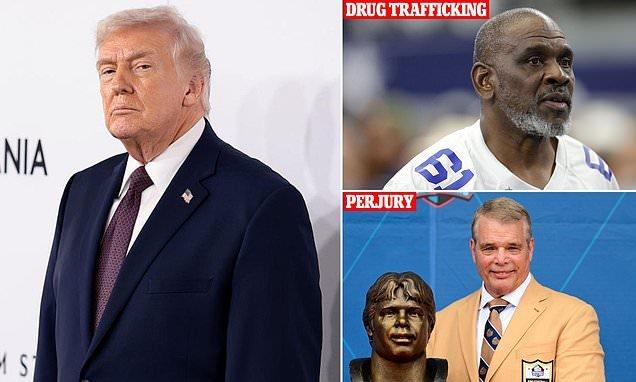
Highly editorialized throughout. Opening with "Felon Trump" immediately frames the president's criminal conviction as the lens through which to view his pardons. Describes the players as "disgraced" in the headline—a characterization, not a fact. Uses loaded phrases like "courtroom deception" instead of "perjury" and "major drug crimes." The article consistently characterizes rather than reports.
Loaded LanguageNarrative FramingAnchoringAppeal to Emotion
“President Donald Trump, himself a convicted felon, has issued pardons to five former NFL players, including one who is already deceased.”
“Their crimes covered offences from courtroom deception to major drug crimes.”
Headline characterizes pardons as "mysterious" and "out of the blue" without evidence they were unexpected—this frames routine presidential clemency as suspicious. The article itself is factual but the framing suggests the pardons require special justification. The mystery angle creates narrative tension where straightforward reporting would be more appropriate.
Loaded LanguageNarrative Framing
“President Donald Trump pardoned five former professional football players - one posthumously - for various crimes ranging from perjury to drug trafficking somewhat out of the blue on Thursday.”
“Johnson wrote on X, as she thanked Trump for his 'continued commitment to second chances.'”
Emphasizes the players' NFL achievements prominently while treating their crimes matter-of-factly. The framing consistently highlights redemption through Johnson's "grit, grace, and courage" quote and describes the pardons neutrally without questioning timing or selection. Mentioning Trump as an "avid football fan" without comment suggests personal interest justifies the pardons.
Narrative FramingSource Selection Bias
“As football reminds us, excellence is built on grit, grace, and the courage to rise again. So is our nation.”
“As of Friday, President Trump, an avid football fan, has not commented on the pardons.”
Generally balanced reporting but ends by highlighting Trump's "controversial" pardon of a Honduran president convicted of helping import "400 tons of cocaine," creating negative association without directly criticizing the NFL player pardons. This context-setting implies a pattern of questionable clemency decisions. The framing subtly questions Trump's judgment while maintaining neutral tone in describing the immediate story.
Narrative FramingContext Stripping
“Trump recently sparked controversy with his pardon of a former Honduran president who was convicted of helping drug smugglers import 400 tons of cocaine into the United States.”
“All of the former players pardoned by Trump had already served prison sentences. The president's pardons now clear their criminal records.”
UPI reporting notes "no formal justification for the surprise pardons was provided," framing them as unexpected and potentially unjustified. Includes context that Trump has granted clemency to "more than 1,700 people, mostly those charged and convicted in connection with the Jan. 6, 2021, insurrection," creating association between these pardons and controversial January 6 clemency. The framing subtly questions the pardons through emphasis on lack of justification.
Selective OmissionNarrative Framing
“No formal justification for the surprise pardons was provided.”
“Since returning to the White House, Trump granted clemency to more than 1,700 people, mostly those charged and convicted in connection with the Jan. 6, 2021, insurrection”
Headline uses attention-grabbing language ("Perjury, drugs, and counterfeiting") that emphasizes criminality over redemption, though the article itself is factual. The crimes are described in detail with specific quantities that make them sound more serious. However, it balances this by including Johnson's redemption framing and quotes Trump's "commitment to second chances."
Loaded LanguageAnchoring
“Henry was arrested after authorities in Montana caught him with 6 pounds of marijuana and more than 6 pounds of cocaine.”
“Johnson called it a 'blessed day' when the pardons were granted, adding that she was grateful to the president for his 'continued commitment to second chances.'”
Straightforward reporting but notes the White House "did not return a request for comment" on why Trump pardoned these players, subtly suggesting opacity. Describes crimes in detail without editorializing but implies the pardons lack clear justification. The framing is neutral but the emphasis on unanswered questions suggests mild skepticism.
Selective Omission
“The White House did not return a request for comment Thursday night on why Trump, an avid sports fan, pardoned the players.”
“Johnson wrote on social media as she thanked Trump for his 'continued commitment to second chances.'”
Factual reporting with detailed descriptions of both crimes and NFL careers. Provides full context including specific quantities of drugs involved and nature of crimes. The neutral tone and comprehensive details allow readers to assess for themselves without editorial guidance. Slight lean comes from detailed crime descriptions that make offenses sound serious without corresponding emphasis on rehabilitation.
“The 64-year-old Newton, a two-time All-Pro and three-time Super Bowl champion offensive lineman with the 1990s Cowboys, was sentenced to 30 months in prison in 2002 after he was arrested with 175lb of marijuana in the trunk of his car near Dallas.”
“Donald Trump issued pardons to five former NFL players on Thursday”
Fox News provides straightforward reporting with emphasis on Johnson's redemption framing and Jerry Jones's personal involvement. The article presents the pardons as routine clemency without questioning or defending them. Slightly favors the administration's framing by prominently featuring Johnson's "grit, grace, and courage" quote without counterbalancing perspectives.
“As football reminds us, excellence is built on grit, grace, and the courage to rise again. So is our nation”
“She added that Dallas Cowboys team owner Jerry Jones shared the news 'personally' with Newton”
Straightforward reporting that includes context on pardons compared to previous presidents, noting Trump granted far fewer in his first term than Obama or Biden. Frames the pardons neutrally as "clemency actions" with minimal editorial characterization. The comparison data provides useful context without suggesting whether Trump's numbers are appropriate.
“Grateful to @POTUS for his continued commitment to second chances”
“By comparison, President Barack Obama granted 1,927 acts of clemency over two terms, and former President Joe Biden granted 4,245 acts of clemency over one term”
Balanced reporting that includes context on Trump's clemency record compared to previous presidents and mentions controversial January 6 pardons for perspective. Provides Johnson's background as someone Trump pardoned. The inclusion of comparative data and broader context helps readers understand how these pardons fit into Trump's overall clemency pattern without editorializing.
“During his first stretch in the White House, Trump approved 238 clemency requests -- far less than former President Obama, who granted 1,927”
“Trump has made several controversial pardons during his second term, including granting around 1,500 requests from those tied to the Jan. 6, 2021, attack on the Capitol.”
LA Times provides detailed, balanced reporting on each player's crimes and careers. Includes comprehensive context on legal issues without sensationalizing. The description of Klecko's bankruptcy fraud as "financial misconduct during a difficult post-football transition" provides humanizing context without excusing the crime. Generally neutral presentation with slight empathy toward the pardoned individuals.
“The legal issue did not involve violence but stemmed from financial misconduct during a difficult post-football transition in which he lied about false car insurance claims.”
“As football reminds us, excellence is built on grit, grace, and the courage to rise again. So is our nation”
Straightforward wire service reporting with balanced details on both crimes and NFL achievements. No editorial characterization of whether the pardons are appropriate. Describes what happened without loaded language or narrative framing. The neutrality is consistent throughout—neither defending nor criticizing the pardons.
“Ms. Johnson wrote on X, thanking Mr. Trump for his 'continued commitment to second chances.'”
“Mr. Newton pleaded guilty to drug trafficking charges in two 2001 cases.”
ESPN's factual sports-focused reporting with equal emphasis on crimes and athletic achievements. No editorial commentary on whether pardons are appropriate. The structure treats each player's full story—both NFL career and legal issues—with balanced detail. Straightforward presentation without narrative framing toward any particular interpretation.
“As football reminds us, excellence is built on grit, grace, and the courage to rise again. So is our nation”
“Klecko, a former star for the New York Jets, pleaded guilty to perjury after lying to a federal grand jury that was investigating insurance fraud.”
Balanced presentation of both crimes and NFL achievements for each player without loaded language. Describes convictions factually without sensationalizing. The structure treats this as routine news rather than controversial. No editorial commentary on whether the pardons are appropriate or problematic.
“Today, the President granted pardons to five former NFL players -- Joe Klecko, Nate Newton, Jamal Lewis, Travis Henry, and the late great Dr. Billy Cannon.”
“As football reminds us, excellence is built on grit, grace, and the courage to rise again.”
Reuters wire service reporting with consistent neutral tone and comprehensive detail on each player's crime and career. No editorial framing or loaded language. The structure simply presents facts in logical order without guiding reader interpretation. Professional wire service standards maintained throughout.
“As football reminds us, excellence is built on grit, grace, and the courage to rise again. So is our nation”
“Klecko, 72, was sentenced to three months in jail in 1993 for lying to a federal grand jury about an auto-insurance fraud scam in which he took part.”
Brief, factual USA TODAY reporting with clear structure listing each player and their crime/sentence without editorial comment. Includes useful definition of what a pardon does legally. The neutrality is consistent—neither celebrating redemption nor questioning appropriateness. Straightforward presentation of facts for reader assessment.
“As football reminds us, excellence is built on grit, grace, and the courage to rise again. So is our nation”
“A pardon permits the president to grant leniency to someone who has committed a federal crime.”
Extremely brief, factual reporting with no editorial framing. Simply states what happened and what the pardons accomplish without characterizing them as good, bad, controversial, or routine. The brevity itself is notable—treating this as straightforward news rather than a story requiring deeper analysis or context.
“The players who received presidential pardons were Joe Klecko, Nate Newton, Jamal Lewis, Travis Henry, and the late Billy Cannon.”
“The pardons clear them of criminal convictions ranging from perjury to drug-related offenses and counterfeiting.”